
Solana’s DePIN sector has transformed from speculative promise to revenue-generating reality, with projects collectively surpassing $2 million in monthly earnings by late 2025. Helium, Hivemapper, GEODNET, Render, UpRock, and NATIX stand out as the top performers, capturing value from wireless connectivity, mapping, geospatial data, compute resources, and AI-driven networks. This breakdown analyzes their revenue trajectories, network expansions, and contributions to Solana’s infrastructure dominance as of February 2026.

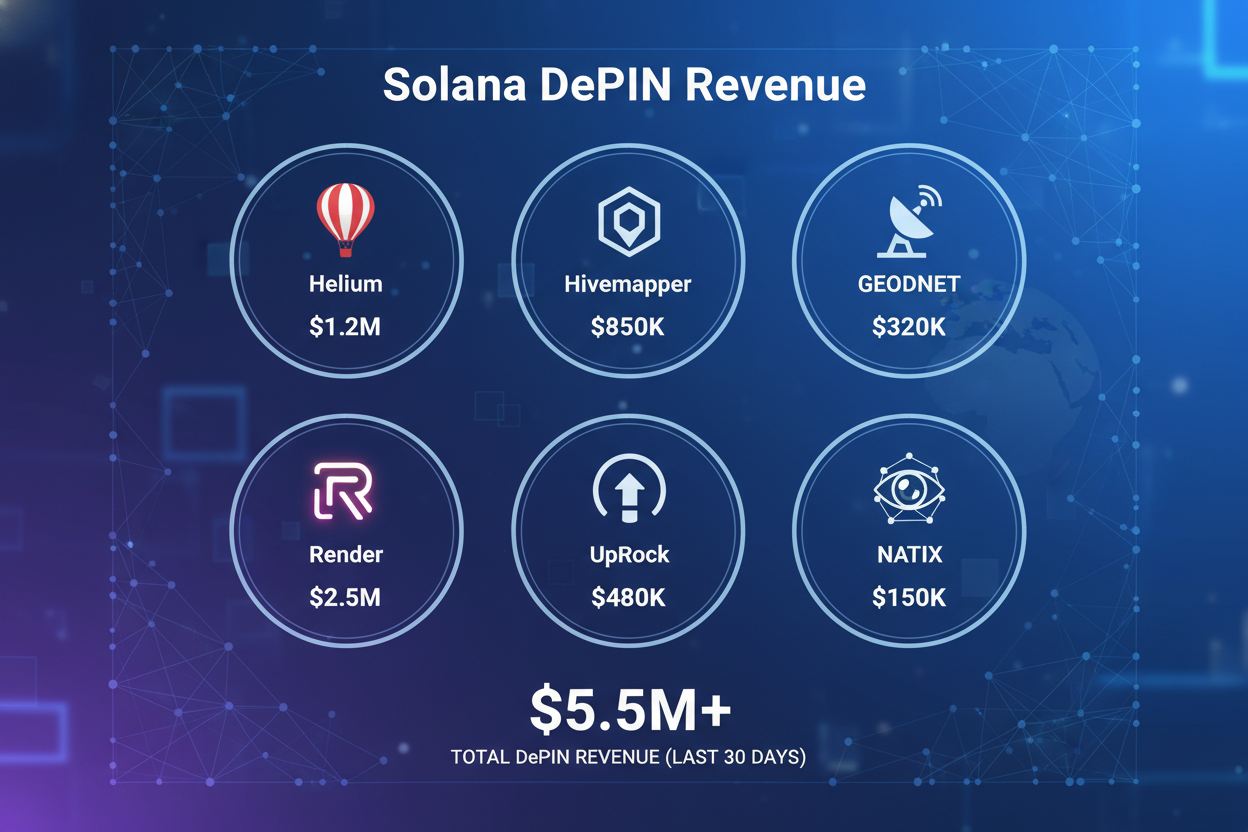
These six projects generated over $2 million monthly in October 2025, stabilizing at peak levels after earlier surges. Helium’s year-to-date revenue reached $6 million, reflecting a staggering 787% growth. Hivemapper hit an all-time high of $77,000 that month, pushing its cumulative earnings past $300,000. GEODNET reported $377,000, bolstered by its network of 17,000 stations delivering precise geolocation data. Render, UpRock, and NATIX complemented this with compute, edge validation, and drive-to-earn contributions, respectively.
Revenue Leaders Driving Solana DePIN Momentum
Solana DePIN revenue has evolved into a key metric for sustainability post-boom. On-chain earnings now anchor valuations, with Solana DePIN projects like these six dominating recent leaderboards. Sources such as Syndica and DePINscan confirm their top positions, with six of the top 10 global DePINs leveraging Solana’s high-throughput chain. This isn’t hype; it’s verifiable token accruals from real-world utility in connectivity, data collection, and processing.
Helium exemplifies this shift, annualizing carrier offload revenues near $35 million while expanding mobile coverage. Its Solana migration enhances scalability for IoT and wireless hotspots, directly tying physical deployments to token incentives. Investors note Helium’s Helium Solana revenue as a benchmark for DePIN maturity.
Helium’s Wireless Dominance and Revenue Engine
Helium leads with unmatched scale in decentralized wireless networks. By October 2025, its revenue hit $6 million year-to-date, fueled by mobile carrier partnerships and offload services. Blockworks data annualizes this at $35 million, where earnings accrue efficiently to network participants via Solana’s low-cost settlements. Hotspot operators earn MOBILE tokens for coverage, bridging crypto to physical telecom infrastructure.
This growth stems from disciplined execution: Solana’s throughput handles surging data loads without congestion, unlike legacy chains. Helium’s integration exemplifies how DePIN monetizes underutilized spectrum, rewarding providers proportionally to uptime and demand. For stakeholders, this translates to predictable yields, with revenue stability signaling long-term viability over token speculation.
Hivemapper and GEODNET: Geospatial Revenue Innovators
Hivemapper redefines mapping through dashcam-equipped vehicles contributing to a global, token-incentivized map. October 2025 marked its revenue peak at $77,000, surpassing $300,000 year-to-date as drivers earn HONEY tokens for fresh imagery. This crowdsourced approach challenges centralized giants like Google Maps, offering verifiable, real-time data superior for AV navigation and urban planning.
GEODNET complements with centimeter-level precision via RTK stations, expanding to 17,000 nodes by late 2025 and generating $377,000 monthly. Miners stake GEODNET tokens for positioning data used in drones, agriculture, and surveying. Its GEODNET Solana miners benefit from Solana’s efficiency, enabling low-latency corrections critical for high-stakes applications. Together, these projects highlight geospatial DePIN’s revenue potential, with combined earnings underscoring Solana’s edge in data-intensive networks.
Render Network extends Solana DePIN into high-demand compute territories, monetizing idle GPUs for rendering, AI training, and video transcoding. Its integration taps Solana’s speed for seamless job distribution, contributing substantially to the sector’s $2 million monthly haul. While exact October figures vary, Render’s consistent performance alongside Helium underscores compute DePIN’s scalability, powering creators who bypass centralized clouds amid rising AI workloads.
Render, UpRock, and NATIX: Compute, Edge, and AI Data Powerhouses
Render’s decentralized rendering model rewards node operators with RNDR tokens for processing tasks, from Hollywood VFX to machine learning inference. Solana’s sub-second finality ensures jobs complete without delays, a edge over slower chains. This positions Render as a cornerstone for top DePIN on Solana, where physical hardware yields crypto returns.
UpRock advances edge validation networks, verifying real-world data at the source through IoT devices and sensors. Participants earn for uptime and accurate proofs, fueling applications in supply chains and smart cities. Its role in the collective revenue surge highlights Solana’s prowess in handling micro-transactions for edge computing, where every validation counts toward network security and utility.
NATIX rounds out the leaders with drive-to-earn mechanics, akin to Hivemapper but laser-focused on AI training data from dashcams. Drivers capture street-level imagery and metadata, earning NATIX tokens for contributions that train computer vision models. This synergy with geospatial peers amplifies Solana DePIN’s data economy, turning vehicles into mobile data centers.
Solana Technical Analysis Chart
Analysis by Market Analyst | Symbol: BINANCE:SOLUSDT | Interval: 1D | Drawings: 6
Technical Analysis Summary
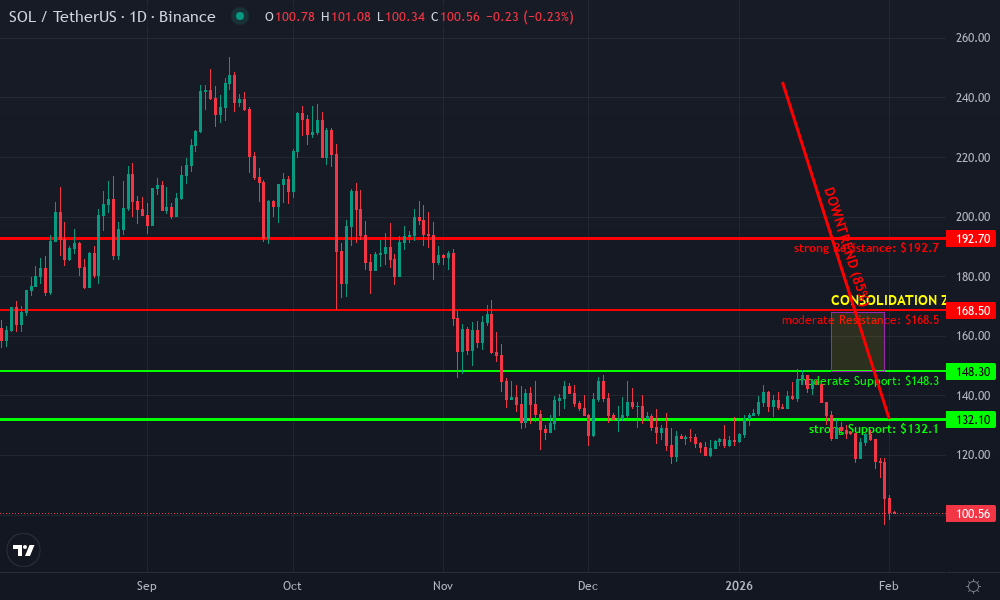
To illustrate the bearish structure on this SOLUSDT chart, start by drawing a prominent downtrend line connecting the swing high around 245 on 2026-01-10 to the recent swing low near 132 on 2026-02-01, extending it forward to project potential further downside to 120. Add horizontal support lines at 132 (major support from recent lows), 148 (prior consolidation base), and resistance at 168 (recent rejection zone) and 192 (mid-channel resistance). Mark a rectangle for the late January consolidation between 148-168 from 2026-01-20 to 2026-01-31. Place arrow markers downward at key breakdown points like the 2026-01-28 drop below 160. Use fib retracement from the 245 high to 132 low, highlighting 50% at ~188 and 61.8% at ~173. Add callouts for volume spike on the breakdown and MACD bearish crossover. Finally, text notes for entry zone at 132-135 with stop above 148.
Risk Assessment: medium
Analysis: Bearish trend intact but nearing strong support amid bullish DePIN news flow; consolidation suggests possible reversal but lacks confirmation
Market Analyst’s Recommendation: Hold off new longs until close above 148 with volume; consider small position at 133 support for medium-risk bounce play targeting 192
Key Support & Resistance Levels
📈 Support Levels:
-
$132.1 – Strong multi-touch low from late Jan/early Feb, volume cluster support
strong -
$148.3 – Prior swing low and consolidation base mid-Jan
moderate
📉 Resistance Levels:
-
$168.5 – Recent breakdown level, now overhead resistance
moderate -
$192.7 – 50% retrace and channel midline resistance
strong
Trading Zones (medium risk tolerance)
🎯 Entry Zones:
-
$133.5 – Bounce from key support 132 with volume increase, potential reversal setup
medium risk -
$147 – Pullback entry on failed resistance retest at 148
low risk
🚪 Exit Zones:
-
$192 – Profit target at channel midline resistance
💰 profit target -
$128 – Stop loss below structure support
🛡️ stop loss
Technical Indicators Analysis
📊 Volume Analysis:
Pattern: decreasing on downside with spike on breakdown
Volume confirms bearish moves, spike on Jan 28 drop validates sellers control
📈 MACD Analysis:
Signal: bearish crossover with histogram contracting
MACD line below signal, no bullish divergence yet, supports continuation risk
Applied TradingView Drawing Utilities
This chart analysis utilizes the following professional drawing tools:
Disclaimer: This technical analysis by Market Analyst is for educational purposes only and should not be considered as financial advice.
Trading involves risk, and you should always do your own research before making investment decisions.
Past performance does not guarantee future results. The analysis reflects the author’s personal methodology and risk tolerance (medium).
These projects’ combined strength reveals a maturing ecosystem. Helium’s wireless backbone supports IoT feeds for GEODNET’s precision and NATIX’s visuals, while Render processes the resulting deluge and UpRock validates it at the edge. Solana’s architecture- low fees, high TPS- glues this together, enabling revenue streams that outpace competitors.
Looking at February 2026 metrics, Solana DePIN revenue holds firm post-October peaks, with sources like Syndica noting sustained $2 million-plus monthly totals. Helium’s 787% YTD growth to $6 million sets the pace, but Hivemapper’s $77,000 October high and GEODNET’s $377,000 with 17,000 stations signal broad-based expansion. Render, UpRock, and NATIX fill critical gaps, their tokens accruing value from tangible deployments rather than hype.
For investors eyeing Solana DePIN revenue surges, these metrics demand scrutiny. On-chain dashboards from DePINscan reveal not just earnings, but uptime, node counts, and query volumes- proxies for moats. Helium’s carrier deals annualizing at $35 million exemplify revenue king status, yet geospatial plays like Hivemapper and GEODNET offer asymmetric upside in underserved markets like autonomous tech.
Risk management tempers enthusiasm: DePIN faces regulatory scrutiny on spectrum use and data privacy, plus competition from incumbents. Still, Solana’s stablecoin boom- from $1.5 billion to $11.7 billion in 18 months- injects liquidity, stabilizing tokenomics. Data-driven decisions favor projects with verifiable physical footprints, where revenue tracks adoption linearly.
Stakeholders should monitor node growth and partnerships; GEODNET’s station ramp-up or NATIX’s AI integrations could catalyze the next leg. Solana DePIN isn’t just infrastructure- it’s the ledger for physical economies, rewarding builders who execute amid volatility. As 2026 unfolds, these six projects position Solana as DePIN’s undisputed hub.
About the Author