
Solana has rapidly become the backbone of the next generation of global stablecoin payments, redefining how digital dollars move across borders and industries. As stablecoins like USDC and USDT gain institutional and consumer traction, Solana’s high-throughput blockchain is emerging as the platform of choice for seamless, low-cost transactions. With a current price of $185.40 for Binance-Peg SOL (SOL), the network’s robust performance is attracting major fintechs, payment processors, and traditional banking giants into its ecosystem.
Solana’s Role in the Global Stablecoin Surge
The payments industry is undergoing a seismic shift as stablecoins transition from speculative assets to core infrastructure for global finance. According to McKinsey and Company, this transformation is poised to accelerate in 2025, with stablecoin payment volumes already exceeding $5.7 trillion annually. Solana is at the epicenter of this growth, powering instant settlement rails that are now being adopted by players like PayPal, Stripe, BitPay, Société Générale, and Western Union.
Why Solana? Its competitive edge lies in its ability to process thousands of transactions per second with sub-cent fees - critical for both retail micropayments and institutional-scale transfers. The network’s composable architecture supports advanced token features such as compliance controls, confidential transfers, and programmable hooks that are essential for regulated entities.
For a visual breakdown of Solana’s explosive stablecoin growth from $5B to $17B in under a year, see this detailed analysis.
Institutional Adoption: From PayPal to Société Générale
The last 18 months have seen an unprecedented influx of institutional adoption on Solana:
- PayPal USD (PYUSD): Launched on Solana in 2024 with features like Confidential Transfers and Transfer Hooks for privacy-centric programmable payments.
- Société Générale: In June 2025, France’s largest bank debuted USD CoinVertible on both Ethereum and Solana - marking the first time a major European lender issued a dollar-pegged stablecoin on-chain.
- Stripe: Enabled merchants across 70 and countries to accept USDC on Solana with instant conversion to fiat balances and near-zero settlement costs.
- BitPay: Integrated SOL and Solana-based stablecoins (USDC/USDT) into its payment stack in August 2025; stablecoins now represent nearly 40% of BitPay’s total payment volume.
- Phantom Wallet: Released Phantom Cash powered by $CASH (a Stripe-acquired asset), offering instant funding via card/bank rails plus Visa-backed spending through Apple Pay/Google Pay.
This wave of adoption isn’t limited to crypto-native startups; legacy fintechs like Western Union are also embracing Solana-powered stablecoins for modernizing remittance flows. For more insights into how neobanks are leveraging these rails, check out this visual guide.
The Engine Behind Low-Cost Global Transfers
The technical foundation underpinning this adoption surge is straightforward yet powerful: throughput and cost efficiency at scale. Compared to legacy blockchains where congestion drives up gas fees during peak periods, Solana consistently delivers sub-second finality with transaction costs measured in fractions of a cent. This reliability enables new business models - from streaming payrolls to e-commerce checkouts - all denominated in digital dollars.
The network’s scalability means it can absorb spikes in transaction volume without sacrificing speed or user experience. Advanced token extensions give enterprises fine-grained control over compliance requirements while unlocking new programmability for automated settlements or escrow services.
Solana Technical Analysis Chart
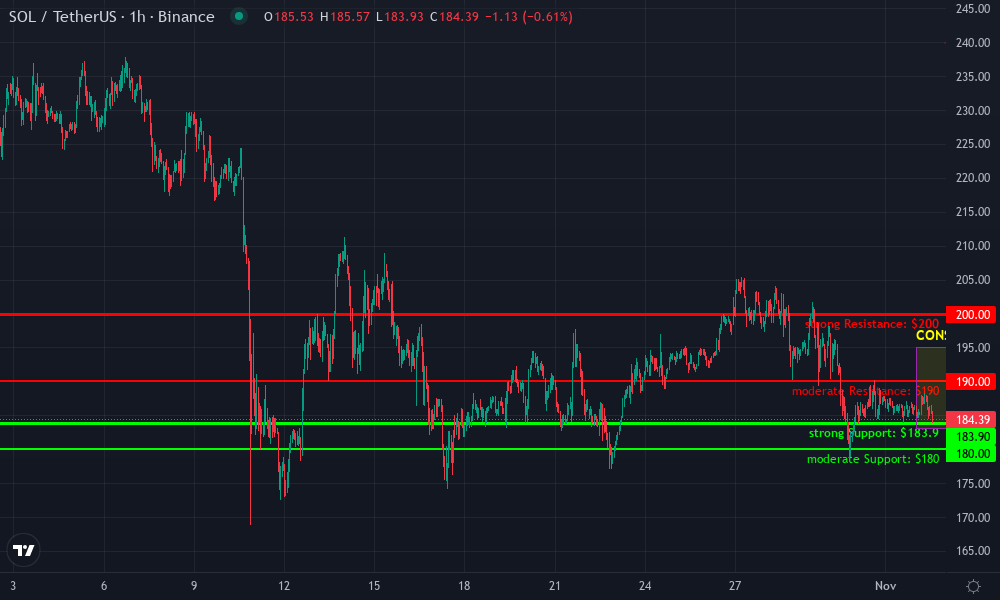
Analysis by Tristan Connors | Symbol: BINANCE:SOLUSDT | Interval: 1h | Drawings: 6
Technical Analysis Summary
Aggressive technicals call for catching the next big move after a major washout and chop phase. Draw a dominant downtrend line from mid-October highs near $240 down through the cascading breakdowns, then highlight the consolidation/basing between $180–$195 since mid-October. Use horizontal lines at $184 (current price/swing lows), $175 (major support), and $200 (psychological resistance). Mark the breakout trigger at $195 and breakdown risk below $180. Rectangle the chop range. Use arrows to highlight failed rallies and capitulation wicks.
Analysis:SOL is trading post-capitulation and pre-breakout, trapped in a volatile range.Both upside and downside expansions are likely and could be rapid.Aggressive strategies are justified,but tight risk management is mandatory given historical volatility and the proximity to major support.
Tristan Connors's Recommendation:Take aggressive range trades with conviction,but respect breakdown risk.Size down and use clear stops below $180.If $195 breaks with volume,pile in for a squeeze;if $180 fails,step aside and wait for capitulation to exhaust.
Key Support & Resistance Levels
📈 Support Levels :
- $184 - Current price zone;base support after capitulation and consolidation.moderate
- $175 - Major support ;last line before open air to the downside.strong
📉 Resistance Levels :
- $195 - Key range top ;breakout triggers above.moderate
- $200 - Psychological and prior structural resistance.strong
Trading Zones (high risk tolerance )
🎯 Entry Zones :
- $185 - Aggressive long entries on reclaim of $185 within consolidation ;targeting mean reversion.high risk
- $195 - Momentum long trigger on breakout and close above $195.medium risk
🚪 Exit Zones :
- $175 - Hard stop loss if price loses $180 and accelerates down.🛡️ stop loss
- $200 - Take profit at prior resistance/psychological level.💰 profit target
Pushing Beyond Borders: Cross-Border Payments and Remittances
A major pain point solved by Solana-powered stablecoins is cross-border value transfer. Traditional wire networks are slow (days not seconds) and expensive ($10-$50 per transfer). With USDC or PYUSD on Solana, funds can move globally almost instantly - enabling businesses to pay suppliers or remote workers without friction or costly intermediaries.
This capability has caught the attention of remittance giants as well as DePIN projects building decentralized financial infrastructure atop the network. To see how these trends compare against other chains or fiat rails heading into 2026, review these latest metrics.
Solana (SOL) Price Prediction 2026-2031
Professional forecast based on Solana's role in global stablecoin payments, current market data ($185.40), and ongoing adoption trends. All prices in USD.
| Year | Minimum Price | Average Price | Maximum Price | YoY % Change (Avg) | Market Scenario Insights |
|---|---|---|---|---|---|
| 2026 | $155.00 | $220.00 | $310.00 | +18.7% | Potential pullback after strong 2025 run; stablecoin adoption supports resilience even if broader crypto sees volatility. |
| 2027 | $195.00 | $265.00 | $380.00 | +20.5% | Ongoing institutional adoption, more fintech integrations, and stablecoin volume growth drive renewed momentum. |
| 2028 | $240.00 | $330.00 | $470.00 | +24.5% | Global stablecoin regulation clarity and increased cross-border payment flows push SOL to new highs. |
| 2029 | $285.00 | $395.00 | $570.00 | +19.7% | Scaling upgrades and new DeFi/payment products on Solana support higher valuations; competition with other L1s intensifies. |
| 2030 | $345.00 | $470.00 | $670.00 | +19.0% | Mainstream stablecoin payments and further fintech/bank adoption consolidate Solana's position, but macro risks may cap upside. |
| 2031 | $410.00 | $555.00 | $800.00 | +18.1% | If Solana maintains tech leadership and stablecoin dominance, SOL could challenge new ATHs; otherwise, market saturation slows growth. |
Price Prediction Summary
Solana is well-positioned as a core blockchain for global stablecoin payments, attracting major financial institutions and fintechs. Continued growth in payment volumes, new stablecoin launches, and technical improvements are likely to drive progressive SOL price appreciation through 2031. However, volatility remains due to competition, macro factors, and potential regulatory shifts.
Key Factors Affecting Solana Price
- Rapid stablecoin adoption for payments on Solana by major firms (PayPal, Stripe, Société Générale, Western Union)
- Low transaction costs and high scalability making Solana attractive for payments and DeFi
- Continued technical upgrades (token extensions, confidential transfers, compliance tools)
- Potential regulatory clarity on stablecoins and blockchain payments
- Increased competition from other high-performance blockchains (Ethereum L2s, Avalanche, etc.)
- Broader crypto market cycles and macroeconomic conditions (interest rates, global adoption)
- Possible network disruptions or security incidents impacting confidence
Disclaimer: Cryptocurrency price predictions are speculative and based on current market analysis. Actual prices may vary significantly due to market volatility, regulatory changes, and other factors. Always do your own research before making investment decisions.
Solana’s stablecoin ecosystem is now a proving ground for next-gen payment rails, not just in crypto but across global finance. The network’s reliability and composability are fueling a new class of fintech products, from instant merchant settlements to borderless payrolls, all while keeping transaction fees negligible. This is especially critical as stablecoin-specific volumes approach $5.7 trillion annually, with Solana capturing a growing share of that flow.

Real-World Use Cases Are Exploding:
- E-commerce: Online merchants leverage Solana-based USDC for instant checkout and settlement, bypassing card networks and reducing chargeback risk.
- Payroll: Global teams receive salaries in stablecoins like PYUSD or USDT on Solana, eliminating delays and FX losses.
- Remittances: Migrant workers send funds home via Solana-powered apps at a fraction of the cost of traditional money transfer services.
- B2B Settlements: Enterprises settle cross-border invoices in seconds using programmable stablecoins with compliance hooks built-in.
The launch of Phantom Cash and Société Générale’s USD CoinVertible underscores how both consumer wallets and regulated institutions are converging on the same rails. The composable nature of Solana DePIN infrastructure means new entrants can build custom payment flows without sacrificing compliance or scalability, a crucial differentiator as regulatory scrutiny intensifies worldwide.
What Sets Solana Apart for Stablecoin Payments?
The technical moat is clear: Solana offers deterministic performance regardless of network congestion, ensuring predictable costs (often less than $0.001 per transaction). Its advanced token extensions allow for features like transfer restrictions, confidential transactions, and on-chain auditability, features increasingly demanded by institutional players. This enables hybrid models where fintechs can offer both open DeFi rails and tightly controlled enterprise flows on the same platform.
For those tracking ecosystem growth or seeking to visualize adoption trends, check out this deep dive into recent all-time high supply milestones: Solana Stablecoins Hit $13.4B ATH.
DePIN Networks and amp; On-Chain Infrastructure
The rise of decentralized physical infrastructure networks (DePIN) on Solana is accelerating the real-world utility of stablecoins even further. Projects are leveraging fast finality and programmable tokens to deliver everything from IoT data marketplaces to decentralized telecom, where microtransactions in USDC or $CASH are settled instantly between machines or service providers. This convergence of digital assets with physical world use cases cements Solana’s role as the backbone for future-proof financial infrastructure.
Looking Ahead: Scaling Into 2026
With Binance-Peg SOL trading at $185.40, investor confidence remains strong despite market volatility. The pipeline for new integrations, from Western Union’s upcoming dollar-backed stablecoin to next-gen DePIN apps, suggests that stablecoin volumes on Solana will continue to set records into 2026. Expect more financial incumbents to launch their own programmable dollars atop this architecture as demand for real-time settlement intensifies globally.
The competitive landscape will inevitably tighten as Ethereum L2s and alternative chains pursue similar opportunities, but few can match the combination of throughput, cost efficiency, and developer tooling that has made Solana the de facto standard for decentralized stablecoin payments today.
Solana Technical Analysis Chart
Analysis by Tristan Connors | Symbol: BINANCE:SOLUSDT | Interval: 1h | Drawings: 7
Technical Analysis Summary
Zoom into the 1-hour chart and use aggressive, sharp trend lines to capture every major swing. Draw a thick horizontal support at $183.90 where multiple wicks and closes cluster, and resistance at $200.00, which capped both the last major rally and several failed attempts. Mark the primary downtrend line from the $240 area down to the $185 zone; then add a secondary uptrend capturing the mid-October recovery. Overlay rectangles to highlight the consolidation band between $183 and $195. Use arrows to mark failed breakout attempts at $200 and deep wicks piercing $180. Add a callout on the heavy volume spike at the large drop around the 10th, and use MACD signal arrows for momentum shifts post-drop and near $195 breakdown.
Risk Assessment:high
Analysis: Volatility remains extreme with no clear trend confirmation.Range-bound action favors aggressive, tactical trades over swing positions.Failed breakdowns and fakeouts are common;sizing and stops must be dynamic.
Tristan Connors's Recommendation: Trade aggressively at range extremes with tight stops.Fade emotional moves.If $180 breaks with volume, flip short and ride momentum;if $190 reclaims,get long for a quick push to $200+.Trade with conviction and stay nimble.
Key Support & Resistance Levels
📈 Support Levels:
- $183.9 - Multiple wicks and closes at this level ; clear demand zone.strong
- $180 - Psychological round number , acted as last - ditch support on sharp drops.moderate
- $175 - Extreme capitulation wick base , real pain point for bulls.moderate
📉 Resistance Levels:
- $190 - Short-term ceiling;capped several upside moves.moderate
- $200 - Major horizontal resistance,capped recent rally and multiple attempts.strong
Trading Zones (high risk tolerance)
🎯 Entry Zones:
- $183.9 - Aggressive long entries on failed breakdowns high risk
- $190 - Breakout long if $190 is reclaimed with volume.medium risk
- $180 - Short entries if $180 fails with momentum.high risk





No comments yet. Be the first to share your thoughts!