
Solana DeFi 2026: The Institutional Shift
Solana’s 2026 narrative has moved beyond raw transaction speed. The network is no longer pitching itself as the fastest chain; it is positioning itself as the most reliable infrastructure for institutional capital. This strategic pivot from throughput to predictability is reshaping the entire Solana DeFi landscape.
The focus has shifted to hardening the network’s resilience, ensuring execution integrity, and delivering predictable finality. For financial institutions, these technical upgrades matter more than headline TPS numbers. They need a chain that behaves like traditional infrastructure—stable, fair, and redundant—rather than a speculative high-performance playground. This shift is what allows Solana to compete with Ethereum for serious DeFi volume.
This reliability is already driving capital inflows into Real-World Assets (RWAs) and structured DeFi products. Kamino, for instance, now holds nearly $1.5 billion in total value locked (TVL) across its lending markets, supporting stablecoins like USDC and USDT alongside major Solana assets. Such scale is only possible when the underlying network is trusted with institutional-grade settlement.
The result is a DeFi ecosystem where capital seeks Solana not for arbitrage speed, but for settlement confidence. As Ethereum continues to dominate in sheer market cap and developer activity, Solana is carving out a distinct niche as the chain of choice for high-frequency, institutional-grade financial applications.
Tracking TVL: Solana vs Ethereum DeFi
The comparison between Solana and Ethereum is no longer just about transaction costs or speed; it is about where liquidity actually resides. While Ethereum remains the undisputed home for institutional-grade stablecoin settlement, Solana has carved out a massive share of the high-frequency trading and retail lending markets. This divergence creates two distinct DeFi ecosystems with different strengths.
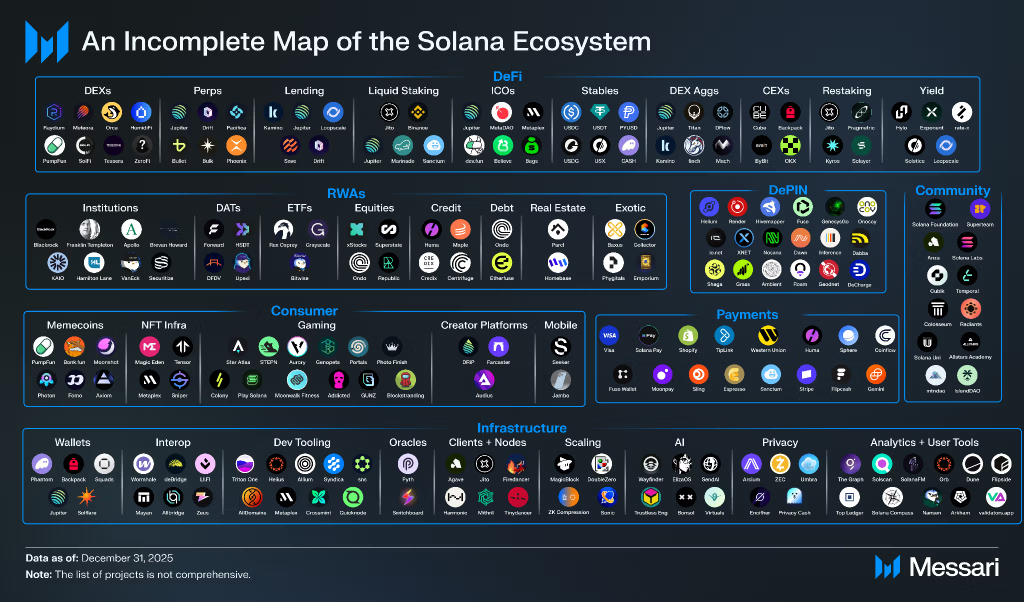
Solana’s Total Value Locked (TVL) is heavily concentrated in a few dominant protocols. Kamino Finance, for instance, has become the largest single DeFi protocol on the network by TVL. Its K-Lend market layer holds approximately $1.48 billion across isolated lending markets, supporting major assets like SOL, USDC, USDT, JUP, and PYUSD. This concentration suggests that Solana’s growth is currently driven by efficiency and yield-seeking behavior rather than the broad, fragmented liquidity seen on Ethereum.
In the decentralized exchange (DEX) sector, the gap is narrowing but distinct. Solana’s spot volume hit $98 billion in February 2026, with Proprietary AMMs (Prop AMMs) capturing 71% of DEX volume. This shift indicates a move toward more sophisticated trading mechanisms that prioritize capital efficiency over the simple automated market maker models that once dominated the space. Ethereum’s DEX volume, while still larger in absolute terms for certain asset classes, struggles with the same frictions that Solana solved: latency and cost.
The following table compares key metrics for the leading protocols in both ecosystems, highlighting the efficiency advantages Solana brings to lending and trading.
| Protocol | Ecosystem | TVL (Est.) | Primary Category |
|---|---|---|---|
| Kamino | Solana | $1.48B | Lending |
| Aave V3 | Ethereum | $16.2B | Lending |
| Jupiter | Solana | N/A (DEX) | DEX Aggregator |
| Uniswap V3 | Ethereum | N/A (DEX) | DEX |
The data reveals a clear split. Ethereum’s lending protocols like Aave maintain a TVL advantage due to their role as the primary settlement layer for institutional capital. However, Solana’s lending growth, led by Kamino, is outpacing Ethereum in terms of velocity and user acquisition. For traders, the choice is less ambiguous: Solana’s DEX aggregators like Jupiter offer a significantly better user experience for high-frequency trading due to lower fees and faster finality. This efficiency is the primary driver of Solana’s DeFi growth in 2026, attracting users who prioritize execution quality over the deep liquidity pools of Ethereum.
Real-World Asset Tokenization Hits $2B
Real-world assets (RWAs) on Solana crossed the $2 billion threshold in March 2026, marking a significant inflection point for institutional adoption. This milestone highlights the network's transition from a high-throughput consumer chain to a serious infrastructure layer for traditional finance. The growth was not driven by speculative tokens, but by the tangible value of tokenized treasuries, credit markets, and private equity instruments.
Institutional players have increasingly favored Solana’s architecture for these assets due to its shift toward predictability and resilience. As noted by Blockdaemon, the 2026 roadmap prioritizes execution integrity and fair access over raw transaction speed. For financial institutions, consistent finality is more valuable than occasional bursts of throughput, reducing the operational risk associated with complex settlement layers.
The ecosystem’s ability to handle large volumes of institutional-grade transactions without congestion has made it a preferred choice for RWA tokenization. Protocols are now leveraging Solana’s parallel processing capabilities to settle complex financial instruments in real-time, a feat that remains challenging on many legacy blockchains. This structural advantage is drawing significant capital from traditional finance firms looking to modernize their settlement processes.
SOL Price Prediction 2026: Market Dynamics
Solana’s price trajectory in 2026 is less about speculative momentum and more about institutional validation. The network’s technical roadmap has shifted from chasing headline transaction speeds to hardening the infrastructure for predictable finality and execution integrity. This pivot is critical; institutions require reliability over raw throughput when allocating capital to digital assets. As Solana transitions from a high-performance chain to a trusted utility layer, its valuation model is recalibrating around real-world usage rather than hype cycles.
The most common question in this space is whether SOL can reach $10,000. The answer is no. Such a valuation would imply a market capitalization exceeding $1.5 trillion, surpassing Ethereum’s all-time high and approaching the total market cap of Bitcoin. This scenario is economically implausible given current adoption curves and competitive constraints. Instead, investors should focus on the sustainable growth driven by Solana’s expanding DeFi ecosystem, where protocols like Kamino are locking up billions in total value. This organic growth provides a stronger foundation for price appreciation than unrealistic moonshot targets.
The gap between Solana and Ethereum remains a central theme in market analysis. While Ethereum dominates in decentralized settlement and security, Solana captures high-frequency trading and consumer-facing applications due to its speed and low costs. This divergence creates a bifurcated market where SOL’s value is tied to its ability to maintain network stability under heavy load. As more real-world assets (RWAs) and institutional liquidity flow into Solana’s DeFi protocols, the price will likely reflect this increased utility. The focus for 2026 is on consolidation and trust, not just expansion.
Key Takeaways for Investors
Solana DeFi in 2026 has shifted from speculative hype to institutional-grade infrastructure. The narrative is no longer just about speed, but about predictability and resilience. As financial institutions look for reliable rails, Solana’s focus on execution integrity and redundancy positions it as a serious competitor to Ethereum in the enterprise space.
The growth of Real-World Assets (RWAs) is a primary driver of this maturation. With RWA value on the network crossing $2 billion in early 2026, the ecosystem is proving its ability to handle tokenized traditional finance. This is not just about novelty; it is about volume and stability.
For investors, the focus should be on protocols that are capturing this institutional flow. Kamino, now the largest single DeFi protocol by TVL with $1.48 billion in isolated lending markets, exemplifies this shift. Similarly, the rise of Prop AMMs, which now account for 71% of DEX volume, shows that sophisticated trading infrastructure is taking hold.
The table below compares the leading protocols by their current utility and market position.
Evaluating exposure requires looking beyond simple price action. The checklist below outlines the core factors to consider when assessing Solana DeFi projects in the current landscape.

Common Questions About Solana DeFi
Investors and developers frequently search for clarity on Solana’s trajectory, price potential, and market dominance. The following answers address the most critical points of confusion regarding the 2026 landscape.
What is the 2026 plan for Solana?
Solana’s 2026 technical roadmap focuses on hardening the network into infrastructure that institutions can trust, rather than simply chasing headline throughput numbers. The development priority has shifted toward predictable finality, execution integrity, and system redundancy. This pivot aims to reduce the volatility that once plagued the chain, making it a more stable foundation for high-value financial applications.
Could Solana hit $10,000?
A $10,000 price target for Solana is highly unlikely under current market conditions. Such a valuation would require a market capitalization that exceeds the total value of most global traditional asset classes, a scenario that defies current economic realities. While Solana remains a high-growth asset, investors should focus on its utility and ecosystem growth rather than speculative, unsustainable price targets.
What is the largest DeFi protocol on Solana?
Kamino is currently the largest single DeFi protocol on Solana by total value locked (TVL). Kamino Lend, the core lending layer introduced with Kamino 2.0, holds approximately $1.48 billion across isolated lending markets. These markets support major Solana assets including SOL, USDC, USDT, JUP, and PYUSD, establishing Kamino as the central liquidity hub for the network’s lending sector.

No comments yet. Be the first to share your thoughts!