
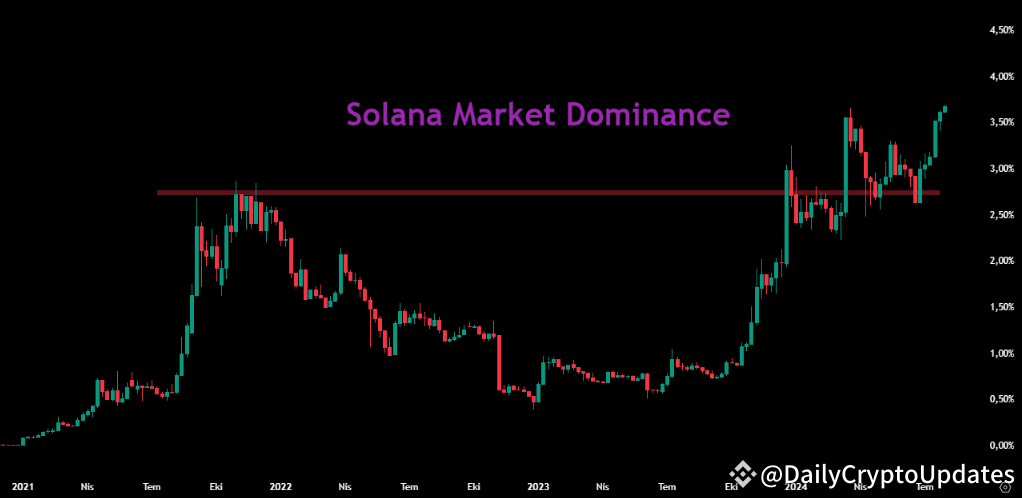
Solana DEX volume overtakes Ethereum
Solana has officially flipped Ethereum in decentralized exchange volume. In May 2026, daily DEX trading volume on Solana surged 79%, surpassing Ethereum on this key metric for the first time. This shift marks a structural change in where capital flows within the crypto market.
The momentum began earlier in the year. By February 2026, Solana crossed $95 million in total DEX volume, ranking number one across all chains. Transaction counts also climbed to 3.4 billion, excluding votes, demonstrating the network's capacity to handle high-frequency retail and institutional activity. Total Value Locked (TVL) simultaneously broke past $600 million, providing the liquidity depth necessary to sustain these volume spikes.
The flippening is not just a headline metric; it reflects a migration of trading activity. Lower fees and faster settlement times on Solana have made it the preferred venue for spot trading and speculative assets. While Ethereum remains dominant in institutional finance and stablecoin issuance, Solana now commands the highest daily trading volume in the DeFi sector.
Solana DeFi volume and DEX dominance
Solana has secured the top position in decentralized exchange (DEX) trading volume, a metric that underscores its growing role in the broader DeFi ecosystem. According to Galaxy Research’s Q1 2026 update, Solana maintained its lead despite a 31% decline in volume compared to previous periods, while other chains faced steeper drops or stagnation. This resilience highlights the network’s ability to retain user activity even during broader market corrections.
The scale of this activity is evident in recent monthly reports. The Solana Ecosystem Report for February 2026 noted that total DEX volume crossed $95 million for that specific reporting window, placing it #1 across all blockchains. Over a longer horizon, CoinGecko data indicates that Solana’s DEX volume has reached approximately $825 million in 24-hour periods, accounting for roughly 18.4% of dominance across all blockchain networks. This market share represents a significant shift in trading liquidity, moving volume away from legacy leaders.
To understand the momentum behind these figures, it helps to look at the price action driving the volume. The chart below shows the recent SOL/USD trading pattern, which correlates with spikes in on-chain activity.
The combination of high transaction counts—3.4 billion in February 2026—and substantial trading volume suggests that Solana is not just attracting speculative trading but also serving as a primary venue for decentralized finance operations. As RWAs grew 58% and stablecoins diversified across the network, the infrastructure has matured beyond simple token swaps.
Liquidity Drivers: RWAs and Stablecoins
Solana’s recent surge in decentralized exchange volume is not merely a reflection of speculative trading. The structural foundation of this growth rests on two converging trends: the rapid institutionalization of Real World Assets (RWAs) and the maturation of a diversified stablecoin ecosystem. As noted in Galaxy Research’s Q1 2026 update, Solana maintained its position as the leading DEX by volume despite a broader market correction, driven by a 58% expansion in RWA tokenization and a more resilient stablecoin infrastructure.
The RWA Institutional Bridge
The tokenization of traditional assets—such as U.S. Treasuries and private credit—has shifted from experimental pilots to core liquidity providers. RWAs on Solana are no longer isolated silos; they are integrated into lending protocols and liquidity pools, effectively bridging traditional finance yield with DeFi composability. This influx of institutional capital has lowered the cost of capital for traders and added depth to order books, reducing slippage during high-volatility events.
Stablecoin Diversification and Efficiency
Historically, Solana’s liquidity was heavily reliant on USDC. Today, the ecosystem has successfully onboarded multiple stablecoin issuers, including USDT and native Solana-optimized tokens. This diversification mitigates regulatory and operational risks while enhancing transaction throughput. The availability of deep liquidity across multiple stablecoins allows for more efficient cross-asset trading, a critical factor for institutional traders who require predictable execution costs.
The following table compares Solana’s current DeFi metrics against Ethereum, highlighting the efficiency gains that drive volume migration.
| Metric | Solana | Ethereum |
|---|---|---|
| TVL | $6.26B | $58.4B |
| Daily DEX Volume | $1.2B+ | $800M |
| Avg. Transaction Cost | <$0.01 | $2.50+ |
| RWA Growth (Q1 2026) | +58% | +12% |
Price Context
To understand the market dynamics driving these volumes, it is essential to view Solana’s price action in the context of network utility. The chart below illustrates the recent price movement, which has been supported by increasing on-chain activity rather than pure speculation.
The interplay between RWAs and stablecoin liquidity has created a flywheel effect. As more institutional assets enter the chain, they require stablecoin pairs for trading, which in turn attracts more retail and professional traders. This structural shift suggests that Solana’s volume leadership is becoming a self-reinforcing cycle, supported by tangible economic activity rather than transient market sentiment.
NFT liquidity and ecosystem depth
The surge in Solana DeFi volume is not an isolated event but part of a broader ecosystem expansion that includes robust NFT liquidity. In April 2026, Solana recorded approximately 167 million monthly SPL token-holder addresses, signaling deep user adoption that extends far beyond simple trading [[src-serp-2]]. This scale provides the necessary liquidity depth for NFT markets to function efficiently, allowing creators and collectors to transact with minimal slippage.\n NFT activity on Solana has matured from speculative hype into a sustainable liquidity layer. Platforms like pump.fun have generated billions in volume, creating a high-velocity environment where digital assets can be bought and sold rapidly [[src-serp-3]]. This volume supports a healthy secondary market, ensuring that NFTs are not just static collectibles but active components of the broader financial ecosystem.
The correlation between DeFi volume and NFT liquidity is critical for long-term health. As DeFi protocols attract more capital, the resulting price stability and user engagement provide a foundation for NFT projects to thrive. This synergy reinforces Solana’s position as a leading chain for digital asset innovation, where high transaction throughput supports both financial instruments and creative media.
Solana price outlook and key levels
Predictions of Solana hitting $200 or $500 often ignore the technical context required to sustain such moves. While the ecosystem’s transaction volume has surged—surpassing Ethereum’s DEX volume in May 2026—price action depends on broader market liquidity and network stability rather than volume alone. Galaxy Research and official Solana ecosystem reports emphasize that high throughput does not automatically translate to immediate capital appreciation.
Technical analysis suggests that any move toward $200 must first break through significant resistance zones established during previous market cycles. A $500 target remains highly speculative and would require a fundamental shift in global macroeconomic conditions, not just network usage. Traders should view these figures as long-term possibilities rather than near-term certainties.
To monitor real-time price action, use the provider-backed widgets below. These tools reflect live market data, ensuring you are not trading on stale information.
Frequently asked: what to check next
How high will Solana get in 2026?
Predicting a specific price target is speculative, but Solana's volume metrics are strong. In May 2026, daily DEX trading volume surged 79% to overtake Ethereum, a key driver for network utility and token demand. While price action depends on broader market conditions, the fundamental shift in DeFi volume suggests sustained interest.
Will Solana hit $200 again?
Solana reached its all-time high near $260 in early 2024. The network is currently trading based on its Q1 2026 fundamentals, where DEX volume remained resilient despite a 31% sector-wide decline. A return to $200 would require a significant expansion of active addresses and total value locked (TVL) beyond current levels.
Could Solana hit $10,000?
A $10,000 price point would require a market capitalization exceeding $1.8 trillion, which is currently unrealistic given the total crypto market size. While Solana's ecosystem is growing rapidly—with over 167 million monthly SPL token-holder addresses in April—such a valuation would demand unprecedented global adoption far beyond current DeFi volumes.
Will Solana hit $500?
Similar to the $200 question, hitting $500 would imply a market cap of roughly $900 billion. While Solana holds a 18.4% dominance in DEX volume across all blockchains, reaching this level would require it to capture a majority of global financial trading volume, a scenario not supported by current growth trajectories.

No comments yet. Be the first to share your thoughts!