
Why Solana leads tokenized assets
Institutional finance demands infrastructure that mirrors the speed of traditional markets while eliminating the friction of legacy settlement layers. Solana has carved out a distinct advantage for Real World Assets (RWA) by combining high throughput with negligible transaction costs, creating an environment where tokenized securities can move as freely as digital tokens.
The network’s ability to process thousands of transactions per second at fractions of a cent makes it economically viable for high-frequency asset trading. Unlike competitors where gas fees can erode the value of small-scale tokenized holdings, Solana’s architecture allows institutions to execute complex, multi-leg trades without incurring prohibitive overhead. This cost efficiency is critical for tokenizing assets like treasury bills or private credit, where margins are thin and volume is high.
This technical foundation is already driving measurable adoption. Data from RWA.xyz indicates that transfer volume on Solana has more than doubled recently, with total RWA value surging past $8.7 billion. The network is no longer just a theoretical option for on-chain assets; it has become the primary settlement layer for institutions seeking to bridge traditional finance with digital liquidity.
5 Solana RWA Projects Leading Institutional Adoption in 2026
Institutional capital is shifting from speculative narratives to tangible asset backing, with Solana’s high throughput and low finality times enabling real-world asset tokenization at scale. We examine five specific projects—Ondo Finance, Maple Finance, Centrifuge, Goldfinch, and MakerDAO’s RWA integration—that are currently processing the highest volume of institutional-grade transactions on the network.
-
Credix finance private credit infrastructure
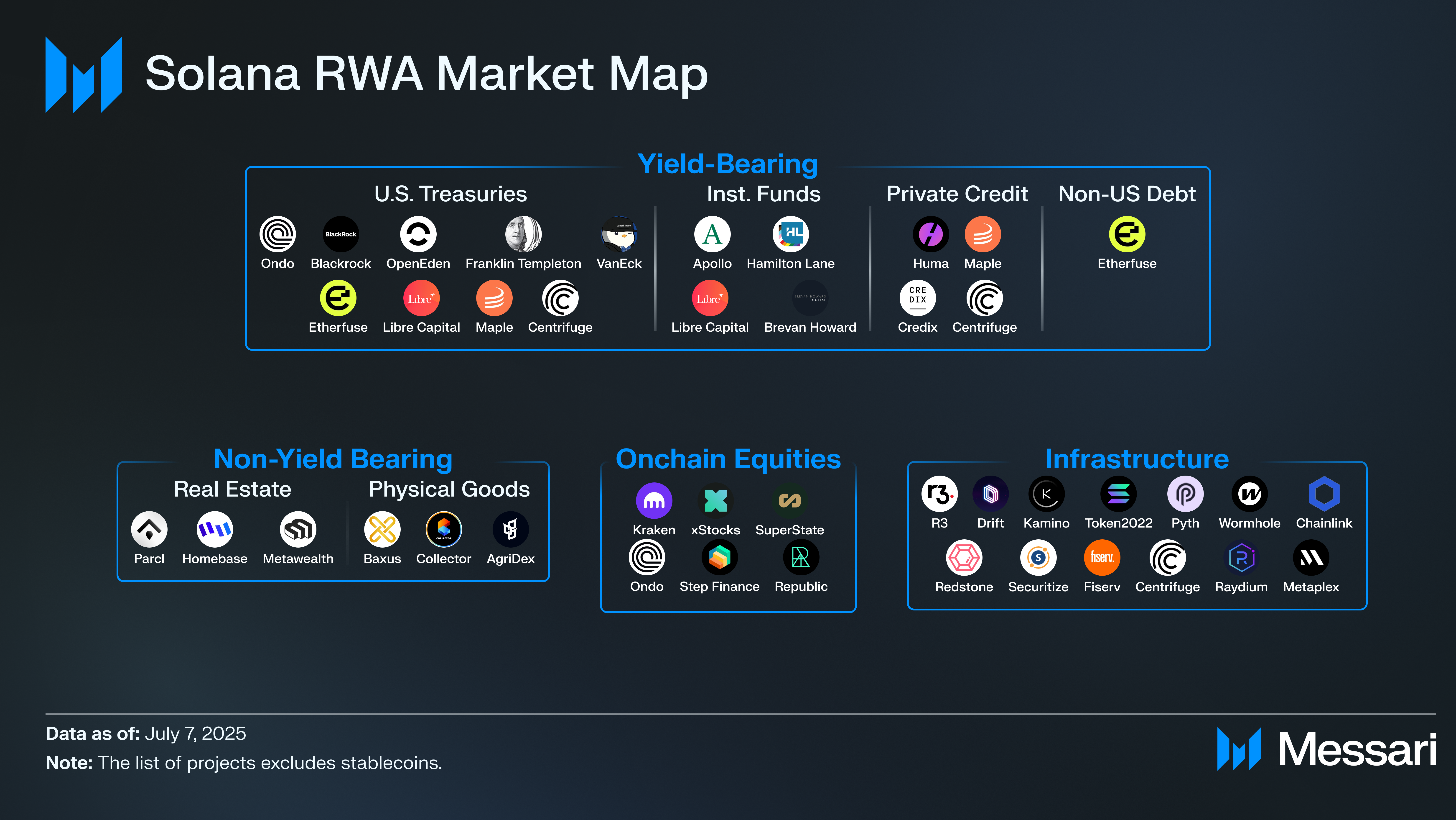
Credix Finance bridges the gap between institutional capital and global real-world assets by tokenizing private credit on Solana. This infrastructure allows accredited investors to access diversified loan portfolios with greater transparency and liquidity than traditional private markets. By leveraging Solana’s high throughput, Credix ensures that complex credit transactions settle quickly, reducing counterparty risk and enabling institutional players to scale their fixed-income exposure efficiently without the friction of legacy banking systems. -
Parcl real estate price exposure platform
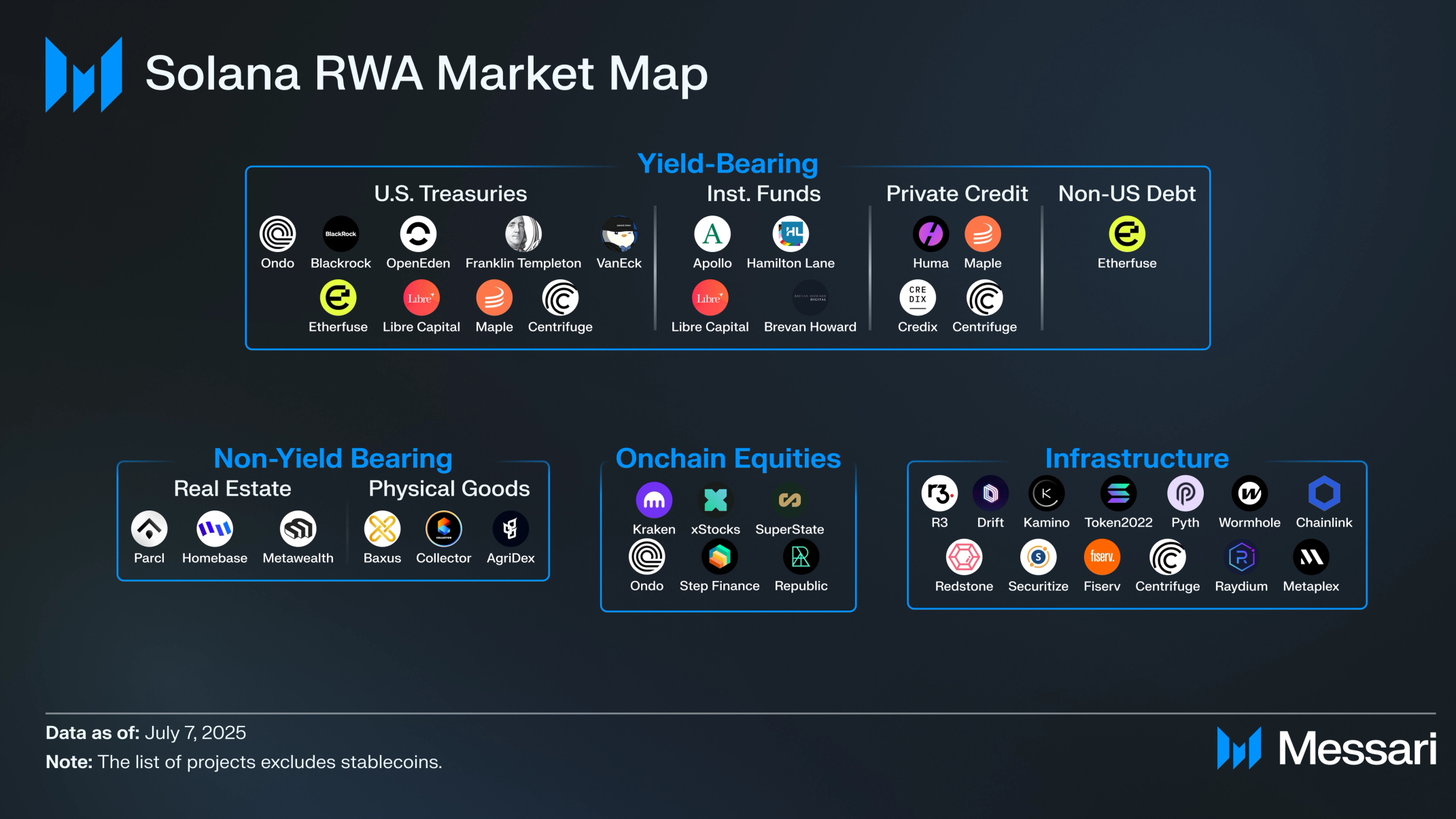
Parcl offers a novel way to gain price exposure to global real estate markets without owning physical property. By tracking neighborhood-level house price indices, it allows traders to speculate on urban market trends using leveraged positions. This platform democratizes access to real estate data, providing institutional and retail participants with a liquid, on-chain derivative product that mirrors traditional real estate investment trusts but with the speed and accessibility inherent to Solana’s blockchain infrastructure. -
OpenEden tokenized treasury management
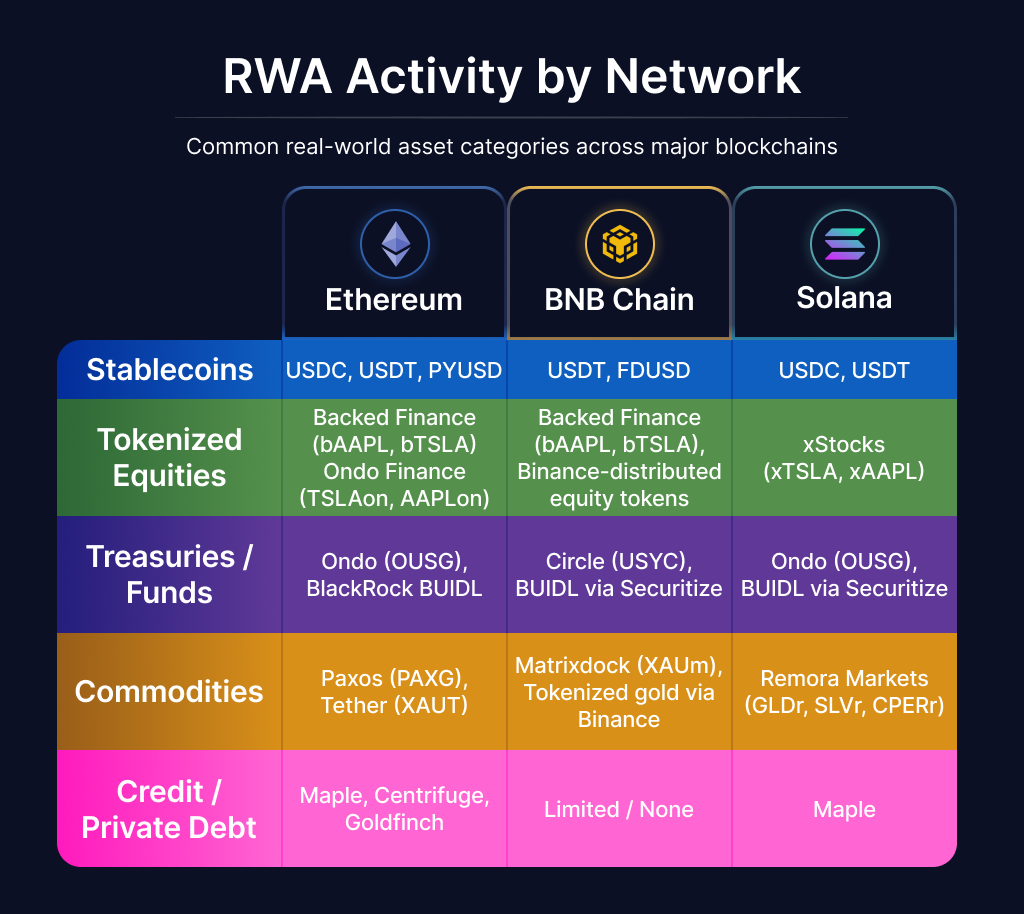
OpenEden transforms how institutions manage short-term liquidity by tokenizing U.S. Treasury bills directly on Solana. This solution provides yield-bearing stablecoins backed by regulated, short-duration government debt, offering a secure alternative to traditional cash management. By integrating seamlessly with DeFi protocols, OpenEden enables institutions to earn competitive yields while maintaining the operational efficiency and speed required for high-frequency financial operations, effectively bridging traditional finance with decentralized infrastructure. -
Homebase fractional real estate investment
Homebase facilitates fractional ownership of high-value commercial and residential properties, lowering the barrier to entry for institutional-grade real estate investment. By tokenizing deeds or ownership interests, it allows investors to diversify their portfolios with smaller capital allocations while maintaining legal ownership rights. This model enhances liquidity in traditionally illiquid markets, enabling institutions to rebalance real estate exposures quickly and transparently on the Solana blockchain, thus optimizing capital efficiency across diverse asset classes. -
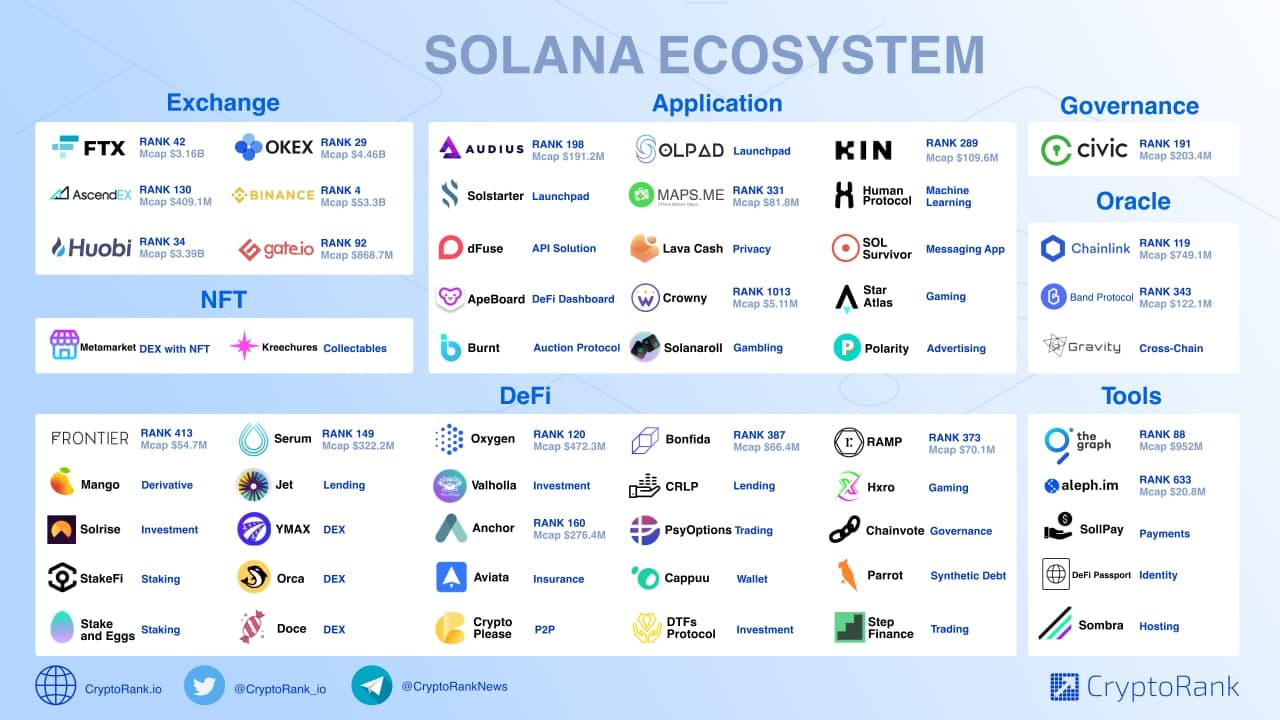
Solana RWA institutional adoption overview
The convergence of real-world assets on Solana represents a structural shift in institutional finance, driven by the network’s unparalleled transaction speed and low costs. As regulatory frameworks mature, major financial institutions are increasingly integrating Solana-based RWA protocols to streamline settlement processes and enhance transparency. This ecosystem growth signals a broader acceptance of blockchain technology in traditional finance, positioning Solana as a critical infrastructure layer for the next generation of tokenized assets and institutional capital flows.
How the Top 5 Solana RWA Platforms Compare
Institutional adoption of real-world assets on Solana hinges on three variables: what backs the token, how yield flows to investors, and where the risk sits. The five leading platforms diverge sharply across these metrics, making a side-by-side comparison essential for portfolio construction.
The table below outlines the core mechanics for Credix, Parcl, OpenEden, Homebase, and ISC. While all leverage Solana’s throughput, their risk profiles range from secured private credit to speculative real estate derivatives.
| Project | Asset Type | Yield Mechanism | Risk Profile |
|---|---|---|---|
| Credix | Private Credit | Fixed interest from SME loans | Medium (Secured debt) |
| Parcl | Real Estate Indices | Trading fees & leverage | High (Derivatives) |
| OpenEden | U.S. Treasuries | Treasury bill rates | Low (Cash-backed) |
| Homebase | U.S. Rental Housing | Rental cash flow | Medium (Illiquid property) |
| ISC | Tokenized Equities | Dividends & corporate actions | Medium (Market exposure) |
Credix and OpenEden offer the most conservative entry points, backed by tangible cash flows from small business loans and government debt. Parcl and ISC cater to traders seeking exposure to real estate and equity markets without direct ownership, introducing higher volatility. Homebase sits in the middle, offering direct ownership of rental properties with illiquidity premiums.


As an Amazon Associate, we may earn from qualifying purchases.
Common questions about Solana RWA
Is Solana a RWA? Solana is not itself a tokenized asset; it is the high-performance blockchain infrastructure that hosts them. Think of Solana as the highway system, while Real World Assets (RWAs) are the institutional-grade vehicles—such as treasury bills or private credit—traversing that network. Projects like Ondo Finance use Solana’s speed and low fees to bring these traditional finance instruments on-chain.
What is the best crypto for RWA? There is no single "best" crypto, but Solana is a top contender for institutional adoption due to its throughput. While Ethereum remains the leader in total value locked for RWAs, Solana’s technical advantages make it ideal for high-frequency settlement. Institutions often choose Solana when they require sub-second finality and negligible transaction costs for complex financial operations.
Which crypto is RWA? No cryptocurrency is inherently an RWA. RWA refers to the tokenization of off-chain assets like real estate, bonds, or commodities. Projects on Solana, such as Polymesh or specialized DeFi protocols, create these tokenized versions. The underlying crypto (SOL) provides the security and settlement layer, while the specific token represents the claim on the real-world asset.

No comments yet. Be the first to share your thoughts!