

Decentralized Physical Infrastructure Networks (DePINs) are rapidly transforming how we build and manage real-world infrastructure using blockchain technology. Yet, as these networks scale from hundreds to millions of devices and data points, they encounter a critical bottleneck: the cost and complexity of storing vast amounts of state data on-chain. Solana’s state compression technology has emerged as a breakthrough solution, enabling DePIN projects to achieve unprecedented scalability and cost efficiency, unlocking new possibilities for decentralized infrastructure.
Why State Compression Matters for DePIN Scaling
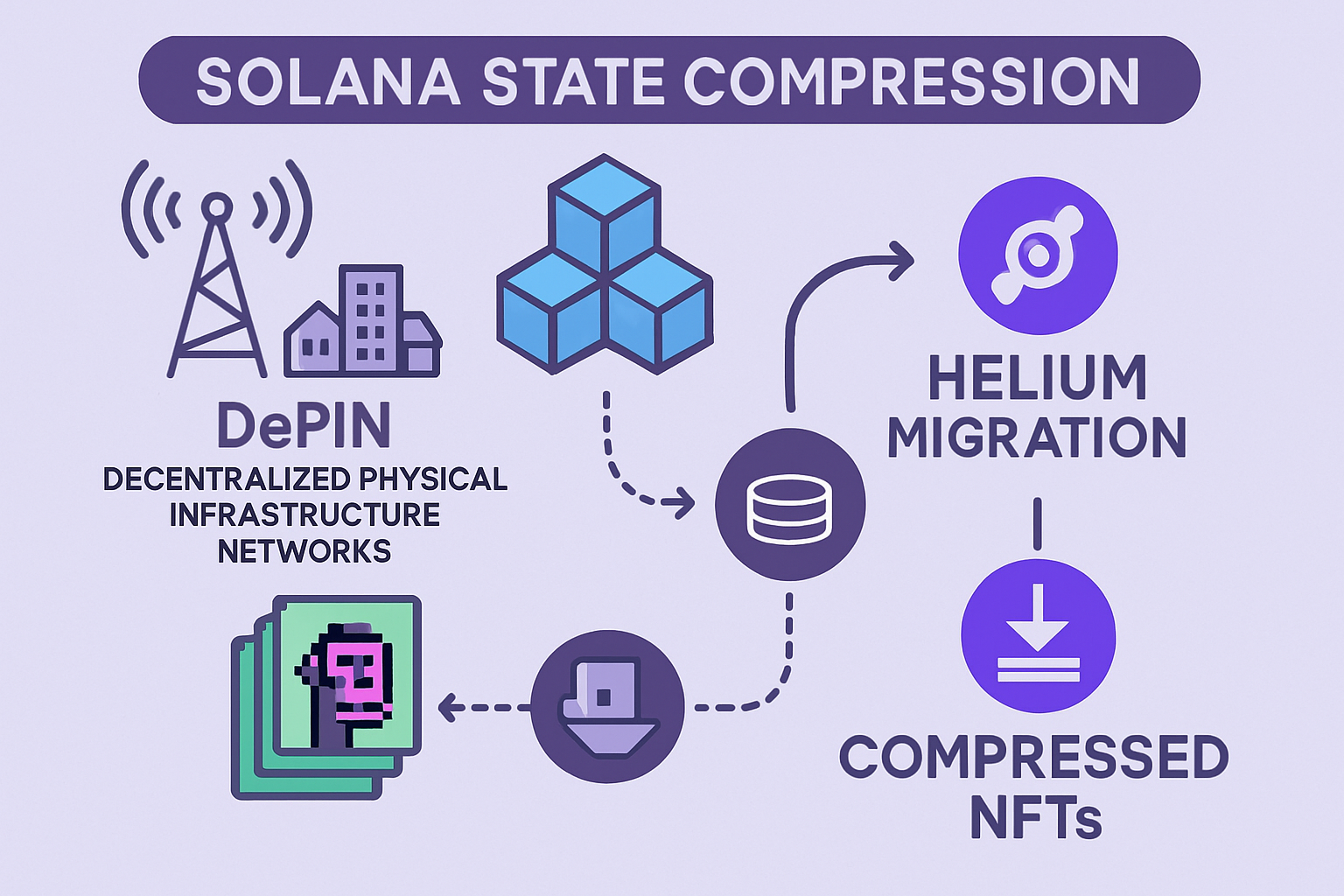
At its core, state compression is a method that leverages compressed Merkle trees to store large sets of on-chain data more efficiently. Instead of recording every device or transaction as a separate, costly entry on the blockchain, Solana’s approach allows for the aggregation and compression of this data, dramatically reducing storage requirements and associated fees.
This innovation is particularly vital for DePIN projects, which often involve high-frequency micro-transactions and dynamic registries of physical assets (such as sensors or hotspots). Without compression, maintaining these records on-chain would be prohibitively expensive and technically cumbersome. With it, however, projects can mint millions of NFTs, each representing a device or data point, for just fractions of a cent per asset.
Helium’s Migration: A Case Study in Compressed Scalability
The migration of Helium, a leading wireless DePIN project, to Solana in April 2023 stands as the most compelling real-world validation of state compression’s impact. Previously limited by its own custom L1 at roughly 10 transactions per second (TPS), Helium’s move to Solana unlocked access to over 1,600 TPS alongside cutting-edge compression features.
During this migration, nearly one million Helium hotspots were minted as compressed NFTs at an astonishingly low total cost of approximately $113 in gas fees. To put this in perspective: without compression, this process would have been orders of magnitude more expensive, potentially costing tens or even hundreds of thousands of dollars. The result? Massive scalability gains with minimal overhead, empowering Helium to focus on its core mission rather than blockchain maintenance.
Solana’s State Compression in Action Across DePIN Verticals
Helium is not alone in harnessing these benefits. Projects like Hivemapper, which relies on user-generated mapping data, also leverage Solana’s state compression to efficiently store vast quantities of geospatial information as compressed NFTs. This enables real-time updates across thousands or millions of contributors without sacrificing decentralization or incurring unsustainable costs.
The broader trend is clear: major DePIN initiatives are converging on Solana not just for its raw throughput but for its uniquely optimized infrastructure stack tailored to physical networks at scale. Whether it’s IoT deployments, wireless mesh networks, or decentralized mapping solutions, the ability to store granular device data cheaply and securely is now table stakes, and Solana is setting the industry standard.
Current Market Context: SOL Price and Ecosystem Momentum
As of November 2025, Solana (SOL) trades at $156.76, reflecting robust ecosystem activity and sustained developer interest in DePIN scaling solutions. The combination of high throughput and innovative features like state compression continues to attract both established projects migrating from legacy chains and new entrants designing infrastructure natively for Solana’s architecture.
It’s worth noting that the economics of state compression ripple far beyond one-off minting events. Every ongoing operation, whether onboarding a new IoT sensor, updating a device’s metadata, or settling micro-rewards, benefits from the same cost efficiencies. For DePIN builders, this translates to predictable, manageable on-chain expenses even as their networks grow exponentially in size and complexity.
This cost predictability is especially critical for projects targeting mainstream adoption. When onboarding thousands of new devices can be accomplished for less than the price of a cup of coffee, DePINs can scale without passing prohibitive costs onto users or stalling growth due to blockchain limitations. In effect, Solana’s state compression is democratizing access to decentralized infrastructure by making it economically viable at every stage of network expansion.
Technical Advantages: Beyond Cost Savings
While cost reduction is the headline benefit, Solana’s state compression also brings technical advantages that are vital for DePIN scaling:
- Atomic Updates: Compressed NFTs allow for efficient batch updates and atomic state changes across thousands of assets in a single transaction.
- Data Integrity: Merkle tree structures ensure tamper-resistance and verifiability at scale, critical for networks where trust in data provenance is paramount.
- Developer Tooling: Solana’s ecosystem offers robust SDKs and libraries that abstract away much of the complexity, accelerating time-to-market for new DePIN applications.
Together, these features give DePIN developers the flexibility to focus on product innovation rather than blockchain optimization. Projects like Helium and Hivemapper have demonstrated how rapid iteration and seamless user experiences are possible when infrastructure isn’t a bottleneck.
Key Takeaways for Builders and Investors
- State compression is now a must-have feature for any DePIN protocol aiming at mass adoption or global coverage.
- The current SOL price ($156.76) reflects both market confidence and real utility being delivered by these innovations across diverse verticals.
- Ecosystem support continues to deepen, with more projects migrating to leverage Solana’s unique blend of speed, cost-efficiency, and developer resources.
The intersection of decentralized infrastructure and scalable blockchain primitives marks one of the most exciting frontiers in Web3 today. With state compression leading the charge, Solana has positioned itself as the execution layer powering tomorrow’s physical networks, efficiently, securely, and at unprecedented scale.





No comments yet. Be the first to share your thoughts!