
Solana 2026 roadmap priorities
Solana's 2026 roadmap marks a decisive pivot from its early reputation as a high-speed experimental chain to a platform built for institutional-grade reliability. The primary objective is no longer just raw throughput, but predictable finality and execution integrity. This shift positions Solana to serve as the backbone of an Internet Capital Market, addressing the volatility and uncertainty that previously limited its adoption by traditional finance.
The core of this transformation rests on two technical pillars: Firedancer and Alpenglow. Firedancer, an independent validator client developed by Jump Crypto, is designed to increase network throughput and resilience by reducing the dependency on a single codebase. Alpenglow, an upgrade to the consensus layer, aims to provide faster and more predictable transaction finality. Together, these upgrades address the historical concerns regarding network stability and downtime, which have been significant barriers for institutional investors.
For financial institutions, the value proposition of Solana in 2026 is defined by this transition to predictability. Reliable finality means that transactions are not just processed quickly, but are confirmed with a level of certainty that meets the strict requirements of high-stakes financial operations. This reliability is essential for the next generation of onchain finance, where settlement times and execution guarantees are as critical as transaction costs.
The market is already reflecting this strategic shift. Solana's price action in 2026 suggests that investors are pricing in the potential of these upgrades, with the asset trading in a range that reflects both current utility and future expectations of institutional adoption.
Firedancer and Alpenglow Upgrades
Solana’s 2026 roadmap shifts the network’s focus from raw speed to institutional-grade reliability. The core of this transition rests on two major technical upgrades: Firedancer, a new validator client, and Alpenglow, an enhanced consensus mechanism. Together, they aim to resolve the network’s historical vulnerabilities to congestion and downtime.
Firedancer, developed by Jump Crypto, replaces the default validator client to enable parallel transaction verification. By processing transactions in parallel rather than sequentially, it drastically increases throughput and reduces latency. This architectural shift is critical for handling the high-frequency trading volumes expected in the 2026 DeFi landscape, ensuring the network remains stable under heavy load.
Alpenglow complements Firedancer by improving consensus finality. It reduces the time required for transactions to be considered irreversible, providing the predictable settlement times that traditional finance institutions require. This combination of parallel execution and faster finality positions Solana to function as a robust backbone for next-generation onchain finance.
AI Agents and Onchain Finance
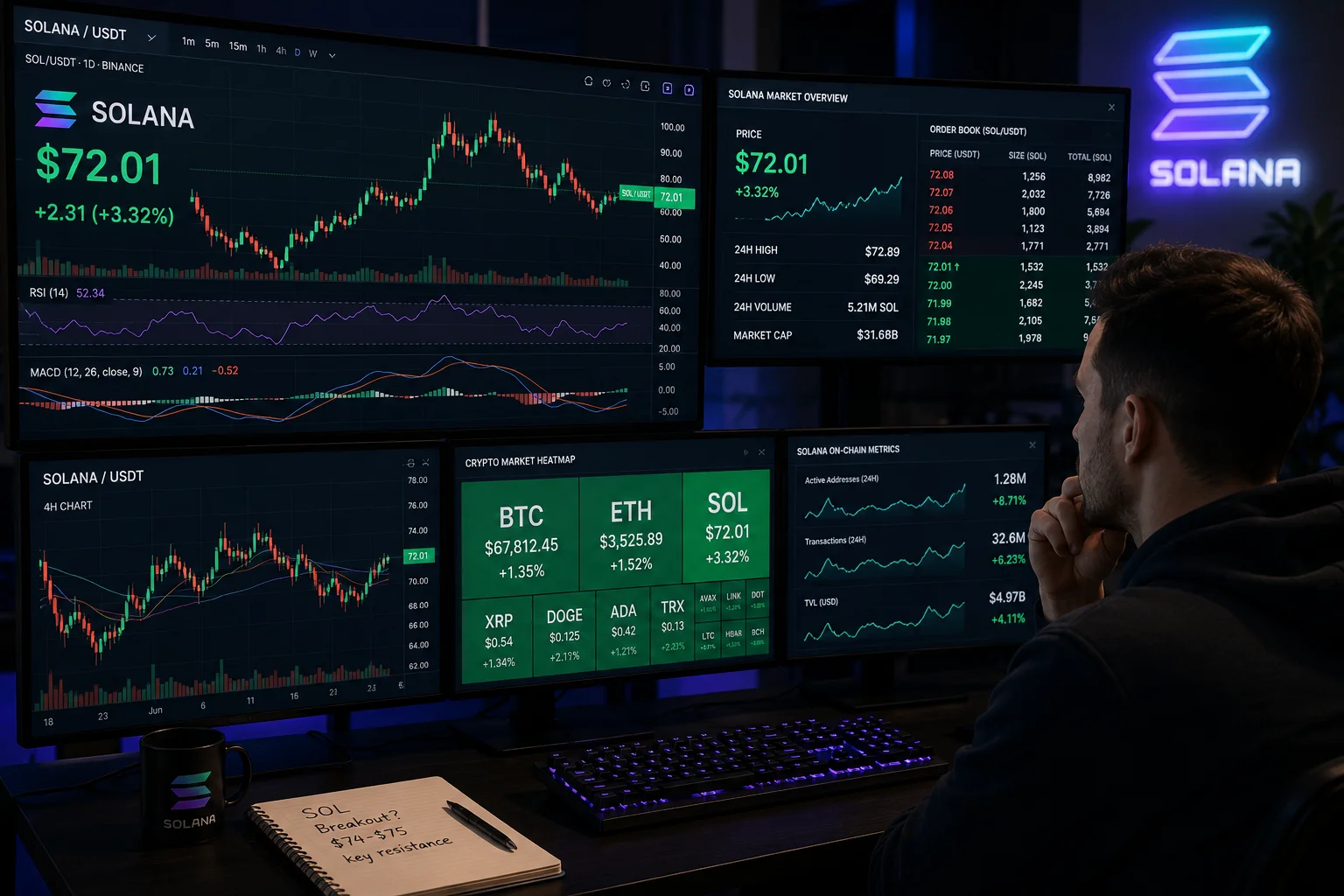
Solana’s architecture is evolving from a high-speed consumer network into the infrastructure layer for autonomous financial agents. The combination of Firedancer’s parallelized validation and the upcoming Alpenglow consensus upgrade creates the deterministic, low-latency environment required for AI-driven high-frequency trading (HFT). This shift allows autonomous agents to execute complex DeFi strategies—such as arbitrage, liquidity provision, and cross-protocol yield optimization—with sub-second finality, effectively creating a new class of onchain liquidity.
The technical foundation for this shift lies in Firedancer’s independent validator client, developed by Jump Crypto. Unlike standard clients, Firedancer bypasses the traditional Linux kernel network stack for direct memory access, drastically reducing transaction processing latency. When paired with Alpenglow, which introduces asynchronous block production and parallelized execution, the network can process thousands of transactions per second without the bottlenecks that previously hindered complex, multi-step DeFi operations. This reliability is critical for AI agents, which require predictable execution windows to manage risk and capitalize on fleeting market inefficiencies.
Autonomous agents are no longer theoretical; they are beginning to populate Solana’s liquidity pools. By leveraging these high-throughput capabilities, agents can monitor onchain data feeds and execute trades across multiple decentralized exchanges (DEXs) simultaneously. This activity increases market depth and efficiency but also introduces new systemic risks, including flash loan attacks and algorithmic cascades. As the ecosystem matures, the focus is shifting toward "execution integrity"—ensuring that these high-speed transactions are not only fast but also secure and resistant to manipulation. This transition positions Solana as the backbone for an Internet Capital Market, where AI agents act as the primary liquidity providers.
Solana 2026 price forecasts
Use this section to make the Solana decision easier to compare in real life, not just on paper. Start with the reader's actual constraint, then separate must-have requirements from details that are merely nice to have. A practical choice should survive normal use, maintenance, timing, and budget. If a recommendation only works in an ideal situation, call that out plainly and give the reader a fallback path.
| Factor | What to check | Why it matters |
|---|---|---|
| Fit | Match the option to the primary use case. | A good deal still fails if it does not fit the job. |
| Condition | Verify age, wear, and service history. | Hidden condition issues erase upfront savings. |
| Cost | Compare purchase price with likely upkeep. | The cheapest option is not always the lowest-cost option. |
Investment Risks and Opportunities for Solana in 2026
Solana’s trajectory in 2026 hinges on its ability to balance institutional credibility with technological resilience. The primary opportunity lies in deepening institutional adoption, notably signaled by Morgan Stanley’s shifting stance on Solana (SOL). This move suggests that traditional finance is beginning to view Solana not just as a high-speed consumer chain, but as a viable infrastructure layer for next-generation onchain finance.
However, significant risks remain. Regulatory uncertainty continues to loom, particularly regarding how decentralized networks will be classified under evolving securities laws. Additionally, competition from Ethereum Layer 2 solutions intensifies. While Solana offers speed, Ethereum L2s provide robust security guarantees and a larger existing developer ecosystem, creating a complex trade-off for institutions deciding where to deploy capital.
To navigate these dynamics, investors should conduct rigorous due diligence. Focus on Solana’s progress with Firedancer, which aims to provide redundant validation and improved network stability. Monitor on-chain metrics that reflect genuine institutional usage rather than speculative volume. The following checklist outlines essential factors to evaluate before committing capital.
-
Verify Firedancer mainnet beta stability and validator diversity
-
Assess regulatory clarity in key jurisdictions for institutional custody
-
Compare Solana’s transaction finality costs against Ethereum L2s
-
Review Solana Foundation’s roadmap for execution integrity upgrades
Solana's 2026 Plan for Institutions
Solana's 2026 roadmap shifts focus from raw transaction speed to predictable finality and execution integrity. The goal is to position the network as the backbone of an "Internet Capital Market" for next-generation onchain finance. This transition prioritizes institutional resilience, ensuring that settlement times and state transitions are deterministic rather than probabilistic.
Central to this plan is the maturation of Firedancer and the Alpenglow protocol upgrade. These technical milestones aim to reduce latency and improve fault tolerance, addressing the reliability concerns that previously limited enterprise adoption. By stabilizing the consensus layer, Solana seeks to meet the strict compliance and audit requirements of traditional financial institutions.

No comments yet. Be the first to share your thoughts!